Product description
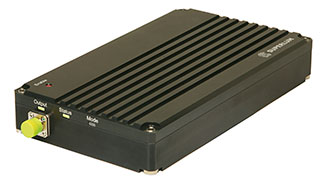
cBLMD-series Broadband Light Source Modules are compact, powerful and very wide spectrum light sources for high resolution OCT and other applications. Standard sources are based on a single (S-) SLD, or on a combination of two (-D) or three (-T) SLDs with different center wavelengths. The design of integrated SLD current and temperature controllers ensure excellent operation stability. In cBLMD-D and cBLMD-T devices, operating parameters of each SLD are pre-set in order to achieve the best combination of spectrum width and output power. Standard models have FC/APC mating sleeve. cBLMD modules are available with internal optical isolators and without them. For models without isolators, optical feedback should not exceed -30 dB. If the optical feedback level is supposed to be higher, consult with a Superlum representative before placing an order.
Please be mindful not only of the intrinsic feedback
level, but also of any occasional feedback that may
arise during the integration and alignment of the
optical system downstream of the light source.
For customers looking for the most broadband and cost effective solutions, we recommend to pay special attention to our UBB (ultra-broad-band) devices. The main design goal of UBB devices is to cover the widest possible spectral range by the minimum number of SLDs combined. Particularly, the cBLMD-D-890-UBB-HP contains only two SLDs which, when combined, provide the 6-dB bandwidth of 190 nm. Although the spectral flatness may be up to 4 dB in UBB-series light sources, they can be successfully used in a large number of applications including Ultra High Resolution Spectral Domain OCT.
Starting 2017, the second generation of cBLMD devices is offered. Every new generation of cBLMD is backward-compatible with the previous generation.
cBLMD design is also recommended for a single-SLD based light source modules if an SLD drive current of up to 600 mA (of up to 900 mA in custom models) is required, or digital control of the SLD is desirable.
Features
- Wide emission spectra
- Fine tuning of spectral shape
- High optical power
- Compact design (dimensions of 190 × 110 × 31 mm)
- Optically isolated models available
- 9-15 V DC supply (12 V DC recommended)
- USB virtual serial port and TTL control; UART upon request
- Companion software with graphical user interface for remote control from a PC/Laptop allowing to change the SLD parameters
- Excellent stability
- Low noise
- Optional optical output overshoot protection with an inline optical power monitor—contact Superlum for more details
- Optional internal Variable Optical Attenuators—contact Superlum for more details
-
Optional 50 kHz on/off modulation feature - contact Superlum
for more details
New Feature—Spectral Control Tool
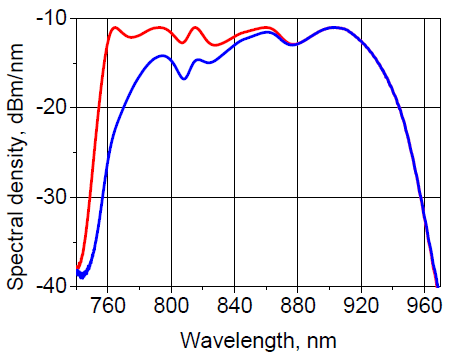
Since 2017, starting with the second-generation cBLMD devices, a new feature, Spectral Control Tool, has been added to cBLMD light source companion software. This tool can be used to adjust the optical spectrum of the cBLMD light source to meet customer-specific application requirements. Changing the spectrum of a 3-SLD model is shown in the figure below (for more details, please refer to Technical Product Specification ).
).
|
|
Changing the spectrum of a 3-SLD model with Spectral Control Tool. Red line - factory settings (all spectral density peaks of the 3 SLDs are equal). Blue line - the SLD1 and SLD2 power levels are set to 60% and 30%, respectively; SLD3 power level remains at factory settings.
|
Optical characteristics of standard models
Main optical parameters of standard cBLMD light source modules are presented in the table below.
Standard cBLMD broadband light sources may have one, two or three SLDs inside. Models containing 2 SLDs are titled as cBLMD-D.
Models containing 3 SLDs are titled as cBLMD-T. An "-I" suffix to a model number indicates that the model contains an optical isolator.
The optical spectrum and the coherence function can be viewed
and downloaded in PDF format.
 – bell-shaped spectrum,
  – multi-humped spectrum.